
Success in Paris
As discovered in a Harper’s Bazar (later Bazaar) issue from October 7, 1899, in 1898 American artist Lee Lufkin (Kaula) sent three paintings to the Champ de Mars in Paris, France. At the time of sending these paintings, Lufkin was a stranger to the Paris art world, not having any acquaintances in the city. However, her portraits were instantly accepted and hung as part of the exhibition, revealing her talented portraiture techniques.
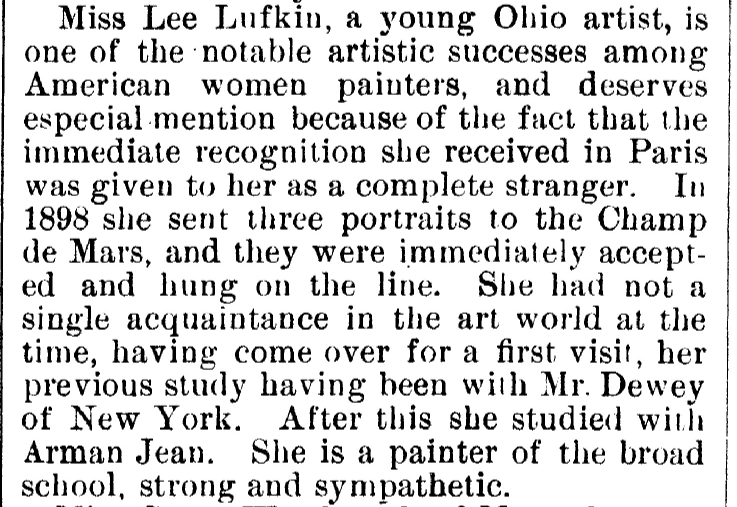
Harper’s Bazar, 1899, page 38, courtesy of the Cornell University Library’s Digital Collection

Lee Lufkin Kaula in her studio at the Fenway Studios Building
Lee Lufkin studied in New York alongside Charles Melville Dewey, an American tonalist painter who had trained in Paris. This led to Lufkin travelling to Paris herself in 1894. The French capital hosted an abundance of artistic activity in the 1890s with artwork exhibitions located in many prominent spaces, such as the Champ de Mars, where Lufkin’s work eventually hung. During her time abroad, she met William J. Kaula, a fellow American artist, and they were married in 1902. Upon their return, they settled in Boston and were among the first occupants of the famed Fenway Studios building constructed in 1905. She joined the Copley Society, the Guild of Boston Artists, the Boston Society of Watercolor Painters, and the National Society of Women Artists, and her works were exhibited in many important venues throughout the United States.

Lee Lufkin Kaula (1865-1957)
Reading
(painted in Fenway Studios photographed above)
“Besides the real aesthetic pleasure one gets from these pictures, from the color and pleasing composition, there is the feeling of satisfaction derived from the sense of clever and sound draughtsmanship. The heads are beautifully modeled, and the hands and arms are splendidly constructed and foreshortened. The delight the artist herself took in producing these pictures is felt by the spectator who views them, who in his turn gets the sensation of enjoyment made upon him by a beautiful color combination, and proving that Ruskin was right when he said that ‘color is meant for the perpetual comfort and delight of the human heart.’”
-“The Art Exhibit: Local Scenes of Nature Painted by the Kaulas Shown at the Athenaeum.” St. Johnsbury Caledonian, October 23, 1912
