
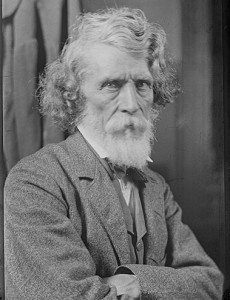
RUSSELL SMITH (1812-1896)
Russell Smith, a pioneering landscape painter of the nineteenth century, brought scientific precision and artistic sensitivity to his depictions of the natural world. Alongside his son Xanthus, Smith helped shape American art through works that combined topographical accuracy with painterly elegance, earning him a lasting place among the era’s most esteemed artists.
Known for their exquisitely rendered landscape paintings, Russell Smith and his son Xanthus (1839-1929) remain firmly established among esteemed artists of the nineteenth century. Russell Smith emigrated with his family from Glasgow, Scotland, in 1819, settling in Pittsburgh, Pennsylvania, at the age of seven. In 1828, he began his formal artistic training under portraitist James Reid Lambdin (1807-1889) and then pursued the arts independently just three years later. He began a longstanding career as a stage set painter and became well-known for his naturalistic scenery, working for theatres from Georgia to Boston until he reached the age of eighty.
After his marriage to floral painter Mary Priscilla Wilson, however, Smith began to focus on painting landscapes inspired by sketching trips around Pennsylvania, and also New England and Europe. Always an astute observer of the natural world, Smith ingeniously combined topographical accuracy with painterly brushwork in his oils, creating literal yet artistically rendered depictions of his surroundings. His interests in science and geology greatly contributed to this scientific realism; Smith was even employed by a number of eminent geologists to illustrate their lectures and record books of their expeditions. While paintings of Pennsylvania and the mid-Atlantic region comprised a large part of his oeuvre, he spent several summers during the 1840s exploring New Hampshire’s White Mountains, and in the early 1850s, he went abroad to Europe for two years with his wife and children.
The Smith family’s European sojourn brought them to England, Scotland, France, Holland, Switzerland and Italy, during which the artist enthusiastically sketched his surroundings and visited museums to observe Old Master paintings. The trip afforded Smith an opportunity to amass an album full of detailed notes and studies, which would serve as valuable references for years to come. Dated 1852 and 1857, Lake Thrasimene (Trasimeno) was one such painting resulting from his time in Italy, which he apparently took up again and polished in 1857. The charming villa in the foreground is rendered with wonderful detail, yet most of the painting is devoted to capturing the beauty of the Italian countryside that initially caught his eye.
In his autobiography of 1884, Smith confided that his small works were never executed with a monetary mission in mind, but rather as pleasing arrangements of hue and values that had somehow impressed him favorably. He became extremely active in the Pennsylvania arts community and exhibited these personal oils and watercolors at the Pennsylvania Academy and the Artists’ Fund Society of Philadelphia, befriending Thomas Birch, Joshua Shaw and John Neagle through these associations. Rembrandt Peale was also among his companions and wrote to an art collector that Smith was a “…most industrious artist, whose landscapes please me chiefly because of their having truth, nature, and Americanism in them.”
After the loss of his wife and daughter in the 1870s, Smith moved in with his son, Xanthus, who was also an artist. Although his style was considered old fashioned, Russell Smith continued to paint for the sheer joy of it and regularly sold works through local dealers. He died at Edgehill, his son’s family home outside of Philadelphia, in 1896.
