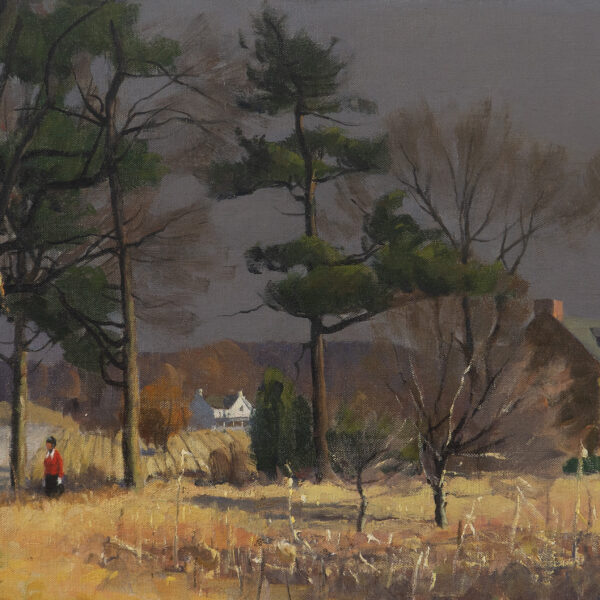
In 1908, Leith-Ross traveled to Paris for two years to study at the Académie Delécluse and the Académie Julian under Jean Paul Laurens, and learned landscape painting in England under Stanhope Forbes. After returning to the United States, he took classes at the National Academy of Design in New York City with Charles Yardley Turner and attended the Art Students League’s summer painting school in Woodstock, New York, under the tutelage of Birge Harrison and John F. Carlson. It was there that he met fellow artist and lifelong friend John F. Folinsbee. In addition to sharing a studio in the summer of 1913, the two would eventually serve as each other’s best man at their weddings and would explore the countryside around Woodstock together, with Leith-Ross carrying Folinsbee on his back since a bout of polio at a young age had left him wheelchair-bound. Although Harrison stopped teaching at Woodstock in 1911, and Carlson took over for him, he maintained close ties with the region and was a powerful influence on Leith-Ross. Impressed with him and Folinsbee, Harrison invited the pair to stay with him and his wife in Woodstock through the winter to study the snow-covered landscape of the Hudson River Valley. From this period, Leith-Ross developed a love for winter scenes and the effect of light and shadow on snow that stayed with him throughout his career.
During his stay with Harrison, Leith-Ross’s work was accepted for exhibition at the National Academy. He returned to Woodstock the following summer, after which Harrison again invited him to stay through the winter, this time in New Hope, Pennsylvania, a newly flourishing art colony in the idyllic region along the Delaware River. Leith-Ross returned to Woodstock the following summer, no longer a student but still an active member of the colony, and submitted works to exhibitions in New York and at the Pennsylvania Academy of the Fine Arts, winning his first award from the Salmagundi Club in 1915. His style from this period combined the vibrant colors of the Impressionists with the tonalism of dawn and dusk light that he acquired from Harrison.
Leith-Ross was still establishing himself in the art world when war broke out in 1917. Putting his career on hold to enlist in the army, he became a second lieutenant stationed at Fort Bliss, Texas, but the war ended before he was deployed. He returned to Woodstock in 1919 and purchased an old barn in which to live and paint, and resumed exhibiting his work. He won numerous prizes and honors, and sold enough paintings to make a living, supplemented by teaching classes at the Woodstock Art Association. Around this time, he also became involved in the art colonies on Massachusetts’ North Shore, teaching at the Rockport Art Association. In 1925, while in Rockport, he met Emily Slaymaker, and they were married later that summer. Their honeymoon took them on a tour through England, Scotland, the Netherlands, and Italy, before they returned to Leith-Ross’s home in Woodstock, where they spent the next ten years, eventually welcoming a daughter, Emily Elizabeth Leith-Ross Mow, in 1927. The following year, Leith-Ross was elected an Associate of the National Academy and became a full National Academician in 1936.