
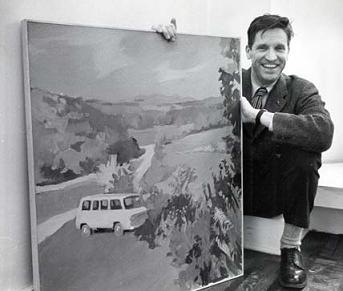
FAIRFIELD PORTER (1907-1975)
Fairfield Wadsworth Porter was an American painter, critic, and writer whose commitment to representational painting distinguished him during a period when Abstract Expressionism dominated the American art world. Best known for his luminous landscapes, intimate interiors, portraits, and still lifes, Porter developed a highly personal style that combined the immediacy of modern painting with an attentive observation of everyday life.
Born in 1907 in Winnetka, Illinois, Porter grew up in an intellectually engaged and financially comfortable family. His father, James Porter, was a prominent architect, and his family’s extensive travels throughout Europe exposed him early to both classical and modern art. After earning a degree in Fine Arts from Harvard University in 1928, Porter continued his studies in art history with renowned scholar Bernard Berenson and later trained at New York’s Art Students League under Boardman Robinson and Thomas Hart Benton.
Two formative experiences profoundly shaped his artistic direction. The first was his friendship with Willem de Kooning and other members of the New York avant-garde, which deepened his understanding of contemporary painting. The second was a 1938 exhibition of works by Édouard Vuillard and Pierre Bonnard at the Art Institute of Chicago. Porter found in these artists a model for combining color, light, and everyday subject matter into paintings that felt both immediate and deeply observed. Their influence remained evident throughout his career.
While many of his contemporaries pursued abstraction, Porter remained devoted to realism. Rather than seeking photographic accuracy, he used color, brushwork, and compositional structure to capture the experience of seeing. His paintings often depict family members, friends, gardens, beaches, houses, and the landscapes surrounding his homes in Southampton, New York, and Great Spruce Head Island, Maine. Through a soft palette and confident, expressive brushstrokes, he transformed ordinary scenes into works of remarkable warmth and visual complexity.
Porter was also an influential art critic and writer. During the 1950s he served as an editorial associate for ArtNews and later wrote criticism for The Nation. His essays reflected his belief that art should be judged on its individual merits rather than through rigid theoretical frameworks. In 1959 he published a respected monograph on the American painter Thomas Eakins, further demonstrating his broad knowledge of art history and criticism.
Throughout his career, Porter maintained close relationships with many leading artists, poets, and writers of his generation. He painted portraits of cultural figures including Larry Rivers, Andy Warhol, and poet John Ashbery, while also documenting the lives of his family and artistic circle. His ability to combine formal sophistication with an unpretentious view of daily life earned him increasing recognition among critics and collectors.
In addition to his artistic and literary pursuits, Porter was known for his independence of thought and engagement with social and environmental issues. He was outspoken on topics ranging from conservation and urban development to war and public policy.
By the final decades of his life, Porter had established himself as one of the most important American figurative painters of the twentieth century. His work anticipated the renewed interest in representational painting that emerged in later generations. Porter died in 1975, leaving behind a body of work celebrated for its intelligence, humanity, and enduring ability to find the extraordinary within the ordinary.
