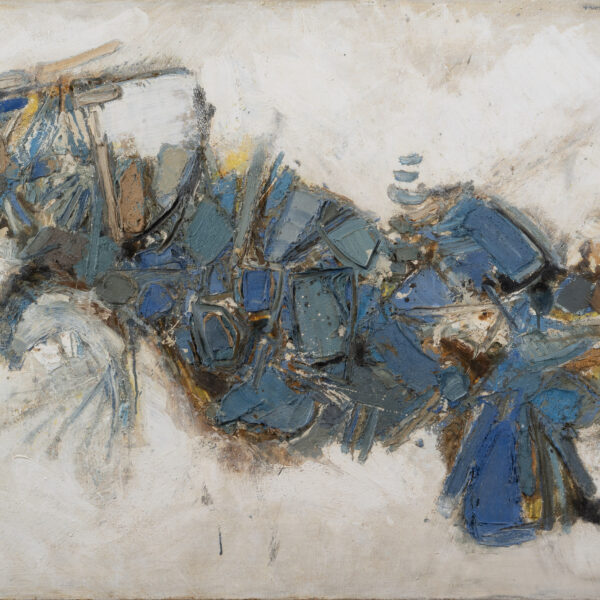
JOHN HARRISON LEVEE (1924-2017)
John Levee (1924-2017) was a major American Abstract Expressionist painter whose career bridged the artistic traditions of postwar America and Paris. Born in Los Angeles, California, Levee grew up in a creatively engaged household. His father, M. C. Levee, was a prominent Hollywood film executive and former president of the Academy of Motion Picture Arts and Sciences, while his mother had worked as a silent-film actress.
Before fully committing to art, Levee pursued an academic path, earning a Master’s degree in Philosophy from UCLA. During World War II, he served as an aviator in the U.S. Army Air Forces and participated in the liberation of France. The experience proved transformative, and after the war he returned to Europe determined to pursue painting rather than a career in aviation.
Following studies at the Art Center School in Los Angeles and later at the Académie Julian in Paris from 1949 to 1951, Levee established himself in Montparnasse, joining a generation of American artists drawn to the energy of postwar Paris. Unlike many of his contemporaries who eventually returned to the United States, Levee chose to remain in France, maintaining a studio there for nearly seven decades.
Levee’s early work was deeply influenced by the New York School of Abstract Expressionism, aligning him with artists such as Franz Kline, Willem de Kooning, Robert Motherwell, Mark Rothko, and Jackson Pollock. His paintings from the 1950s are distinguished by vigorous brushwork, dramatic gestures, and heavily textured impasto surfaces that emphasize paint as a physical, expressive material. Critics frequently noted the force, emotional intensity, and gravitas of his work, as well as his ability to balance raw energy with sophisticated formal structure.
During the 1960s and 1970s, Levee explored hard-edge painting and geometric abstraction, producing compositions marked by crisp forms and architectural clarity. By the mid-1980s, however, he returned to a more spontaneous and painterly approach, incorporating elements of lyrical abstraction, collage, and richly layered surfaces. Throughout his career, his work remained rooted in a belief that painting could communicate through gesture, color, and material presence rather than narrative imagery.
In addition to his studio practice, Levee taught at numerous American institutions, including the University of Illinois, Washington University in St. Louis, New York University, and the University of Southern California. His paintings received international recognition and entered major museum collections, including the Museum of Modern Art, the Solomon R. Guggenheim Museum, the Whitney Museum of American Art, the Brooklyn Museum, and the Tel Aviv Museum of Art.
Today, John Levee is recognized as one of the most significant American painters to make Paris his lifelong artistic home. His work occupies a distinctive place within postwar abstraction, uniting the bold physicality of Abstract Expressionism with the intellectual rigor and international outlook that defined his remarkable career.