
250 Years of Art in Boston
In honor of the 250th anniversary of the American Revolution, Boston 250: Our City’s Enduring Influence celebrates the profound and lasting impact Boston has had on the cultural, artistic, and political identity of our country.

This exhibition brings together a dynamic selection of Boston-themed artworks that reflect the city’s pivotal role in shaping the nation’s spirit of independence, innovation, and creativity. From historic street scenes, such as Enrico Meneghelli’s Old South Meeting House, to the work of Boston School luminaries Frank Benson and Edmund Tarbell, these paintings capture the essence of a city whose influence resonates far beyond its borders—and whose artists continue to define and reflect its storied legacy.
Enrico Meneghelli’s skilled precision can be found in his charming outdoor scenes of the rapidly expanding city, as seen in Old South Meeting House, Washington Street, Boston, Massachusetts. Built in 1729 and now celebrated as the second oldest church in Boston (after Old North in the North End), the Old South Meeting House served many purposes over its history: a place of worship, a town hall, and site of vociferous debate over the tea tax and subsequent planning of the Boston Tea Party in December 1773.
The historic building now hosts a permanent exhibition to the city’s storied past; it survived revolution, conflagration (in the form of the Great Boston Fire of 1872), and near ruination, and now endures as a beacon of the freedom of expression for which the American colonists fought so dearly.

Enrico Meneghelli (1853-1912)
Old South Meeting House, Washington Street, Boston, Massachusetts

Arthur Clifton Goodwin (1864-1929)
The Marble Lady, Public Garden, Boston
Arthur C. (A.C.) Goodwin, the self-taught “Beau Brummel of Chelsea,” was a bold and independent voice in Boston’s early 20th-century art scene. Known for his moody, light-filled views of Boston’s wharves, streets, and gardens, Goodwin was praised by Childe Hassam and admired by figures like John Singer Sargent and Isabella Stewart Gardner. Though he defied strict stylistic labels, his Impressionist-influenced cityscapes earned him national acclaim and exhibitions at the MFA Boston, the Art Institute of Chicago, and the National Academy of Design.
Painted in 1895, My Little Girl is a striking depiction of Frank Weston Benson’s firstborn child, Eleanor, who would eventually appear in at least sixteen canvases over the course of his career. Her steady gaze immediately engages the viewer, as does her stark white dress, glowing against the shadowy room beyond and rendered with ruffled accents echoing the curved sweep of her hair. Like the dozing cat standing stoically by her side, five-year-old Eleanor betrays none of the restlessness one might expect of a child asked to remain still for her artist father, and for this reason she became one of Benson’s favorites of his ‘homegrown models.’
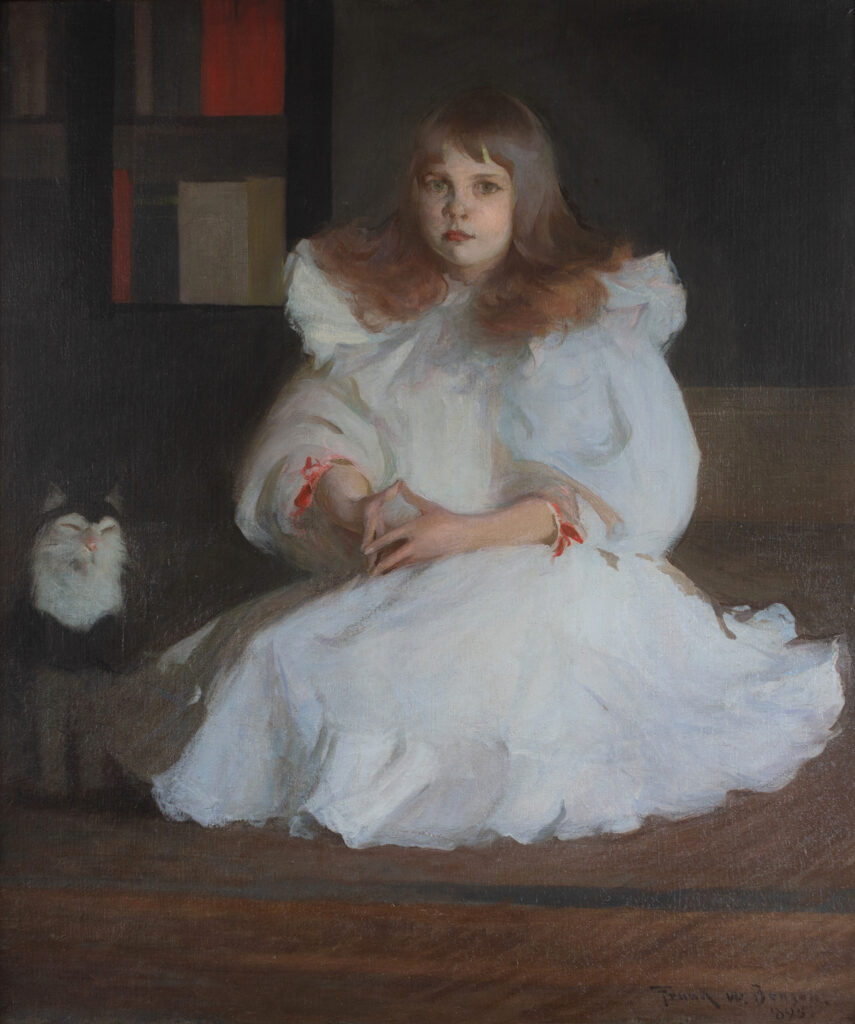
Frank Weston Benson (1862-1951)
My Little Girl

John Stobart (1929-2023)
Boston, The Departure
British-born maritime painter John Stobart was renowned for his dramatic, meticulously researched views of historic American ports—Boston chief among them. Over his career, he became one of the most celebrated and financially successful maritime artists of the 20th century, earning honors from institutions like the Royal Society of Marine Artists and receiving the American Society of Marine Artists’ Award of Excellence. His romantic visions of clipper ships and Boston Harbor preserve a golden era of maritime history that continues to captivate collectors and historians alike.
